
- July 3, 2013
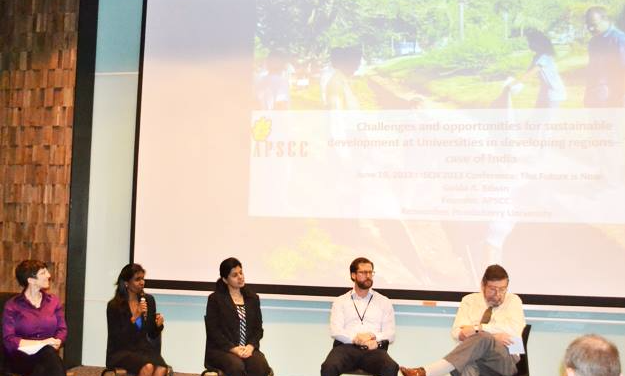
The 7th annual ISCN event was co-hosted by the International Sustainable Campus Network and the National University of Singapore.Combining the suggestions of her fellow panelists, Golda Edwin, APSCC, tackled the topic of describing what a sustainable campus looks like in a developing country.
The 7th Annual International Sustainable Campus Network (ISCN) Conference, co-hosted by the National University of Singapore (NUS), brought together global leaders in sustainability to address the theme “The Future is Now.” Held in June, 2013, in Singapore, the event showcased best practices, innovative approaches, and visionary strategies for advancing campus sustainability worldwide.
The conference served as a call to action for universities to accelerate their contributions to sustainable development and to catalyze transformative change for a sustainable future. Leaders from academic institutions, industries, and sustainability networks gathered to exchange ideas, foster collaboration, and celebrate achievements in campus sustainability.
APSCC’s Insightful Contribution
A highlight of the conference was the plenary session titled “Growth vs. Sustainability: Are These Mutually Exclusive Goals?” Among the distinguished speakers, Dr. Golda Edwin of the Association for Promoting Sustainability in Campuses and Communities (APSCC), provided an insightful perspective on what a sustainable campus looks like in a developing country.
Drawing on APSCC’s experiences in fostering sustainability in diverse campus environments, Edwin shared actionable strategies for developing countries, emphasizing the need for:
- Cost-effective solutions that align with local resources and cultural contexts.
- Community engagement to ensure sustainability efforts have grassroots support and impact.
- Education and awareness programs to create a culture of environmental stewardship among students, faculty, and staff.
Edwin’s presentation highlighted the importance of adapting global sustainability frameworks to local realities, ensuring that the path toward sustainable campuses is inclusive and equitable.
Keynotes and Plenary Highlights
The conference featured thought-provoking keynote addresses from global sustainability leaders:
•Professor Tommy Koh, Ambassador-At-Large, Ministry of Foreign Affairs of Singapore, emphasized the urgent need for global cooperation in addressing climate challenges.
•Dr. Gerhard Schmitt, Director of the Singapore-ETH Centre, shared innovative approaches to urban sustainability and campus design.
Plenary sessions addressed critical themes, including:
•Beyond Carbon: The Next Generation of Sustainability Goals
Speakers like Rosi Kerr (Dartmouth College) and Christopher Silva (Hamad bin Khalifa University) discussed the importance of redefining sustainability metrics beyond carbon footprints to include social equity and resilience.
•Engaging Universities in Co-Creation for Urban Sustainability
Thought leaders such as Esther Barazzone (Chatham University) and Greg Trencher (University of Tokyo) explored the intersection of academic research and urban planning.
Campus Sustainability Awards
The conference celebrated outstanding sustainability achievements through the Campus Sustainability Awards, recognizing universities for their innovation and leadership:
- Excellence in Building: University of Gothenburg
- Excellence in Campus: Lappeenranta University of Technology
- Excellence in Integration: Chatham University and Anglia Ruskin University
- Excellence in Student Leadership: Zhejiang University
These awards underscored the diverse ways in which campuses can lead the charge toward sustainability, from eco-friendly infrastructure to fostering student-led initiatives.
A Collaborative Future
The ISCN 2013 Conference was more than an event; it was a powerful reminder of the role universities play in shaping a sustainable future. By sharing best practices and fostering dialogue, institutions worldwide are better equipped to address the challenges of climate change, resource conservation, and community resilience.
The participation of APSCC and the contributions of leaders like Golda Edwin demonstrated the importance of tailoring global sustainability goals to local contexts. As universities continue to innovate and collaborate, the vision of a sustainable world led by knowledge, innovation, and inclusivity becomes ever more achievable.
For more information and access to conference materials, visit the ISCN 2013 Conference Summary Report and presentation archives.