- August 20, 2017

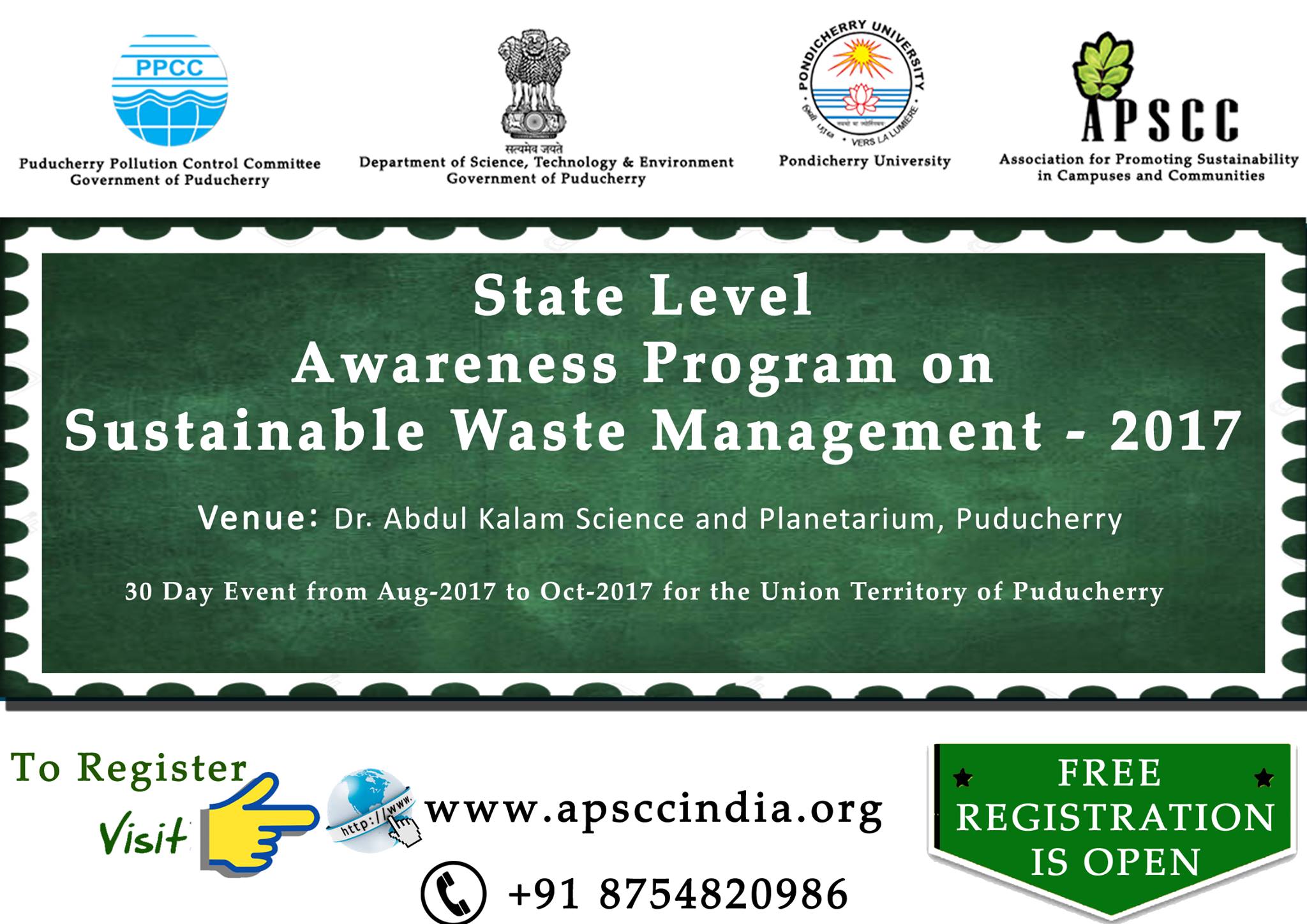
The State-Level Awareness Program on Sustainable Waste Management (SLAPSWM) 2017-18 marked a milestone in environmental consciousness for the Union Territory of Puducherry. Organized by the Puducherry Pollution Control Committee (PPCC) in collaboration with the Department of Science, Technology, and Environment (DST&E), Pondicherry University, and the Association for Promoting Sustainability in Campuses and Communities (APSCC), this comprehensive initiative spanned multiple months, reaching over 5,000 participants across Puducherry, Karaikal, Mahe, and Yanam.
A Vision for Sustainability
The program aimed to foster awareness about the new sustainable waste management rules introduced by the Ministry of Environment, Forest and Climate Change, India. It served as a platform for educating diverse stakeholders—students, researchers, faculty, government officials, healthcare professionals, architects, community workers, and more—on the urgent need for sustainable waste practices.
The State-Level Awareness Program on Sustainable Waste Management (SLAPSWM) was a landmark initiative that brought together over 10,000 participants from diverse sectors, including educational institutions, industries, municipalities, NGOs, and community organizations. This extensive participation underscored the program’s commitment to fostering a wide-reaching impact across societal strata. The sessions, led by more than 90 resource persons, provided valuable insights into effective waste management practices, covering educational institutions, industrial settings, residential spaces, and community areas. Through engaging discussions, hands-on workshops, and interactive presentations, participants delved into essential topics such as waste segregation, recycling, hazardous waste disposal, and sustainable solutions for tackling pressing environmental challenges.
A key achievement of the program was the development of a Comprehensive Green Protocol, designed as a practical guide for institutions and organizations to integrate sustainable practices into their operations. This protocol outlines clear standard operating procedures for environmental governance, making sustainability a core organizational value. The program also initiated transformative actions, with institutions like JIPMER and PIMS implementing campus-level waste management projects, establishing biogas plants, and launching campaigns to reduce plastic use.
The inaugural event, held at the Dr. Abdul Kalam Science Center and Planetarium, was graced by distinguished dignitaries, including the Hon’ble Chief Minister Shri. V. Narayanasamy and Secretary DST&E Shri. R. Mihir Vardhan, I.A.S., setting the tone for the program’s ambitious goals. Participants across sectors commended the initiative for its thoughtful approach and actionable outcomes. Dr. Ashok Shankar Badhe of JIPMER highlighted its significance in addressing environmental challenges, while the Principal of Kanchi Mamunivar Center for Postgraduate Studies praised its emphasis on resource-sharing and sustainability education.
By equipping communities with the knowledge and tools to adopt sustainable practices, SLAPSWM demonstrated the power of collective action in creating a cleaner, greener future. It served as a vital platform for fostering partnerships and inspiring transformative changes in waste management at both local and institutional levels.
A Roadmap for the Future
SLAPSWM 2017-18 has laid a solid foundation for sustainable waste management in Puducherry. By combining education, policy, and community action, this initiative highlights the critical role of awareness in tackling environmental challenges. It also underscores the importance of partnerships among governments, academia, and communities in achieving sustainability goals.
