ICCARP — International Climate Change Adaptation & Resilience Program

Global Engagement · ICCARP

Empowering institutions for climate action.

The International Climate Change Adaptation & Resilience Program positions universities, colleges and schools as agents of change — connecting local roots and global networks to advance the SDGs through education, research and action.

Our vision for the future

Campuses as beacons of sustainability.

ICCARP envisions a world where educational institutions act as hubs for climate adaptation and resilience — driving meaningful change locally and globally. By equipping future generations with the knowledge and tools to combat climate change, ICCARP fosters an era of innovation, collaboration and sustainable development.

Sustainability is the defining theme of today; sustainable development is our shared goal for tomorrow. Universities, uniquely rooted locally yet connected globally, are pivotal change agents — addressing grand challenges like climate change and biodiversity loss through innovation, research and education.

The framework

Six pathways, one mission.

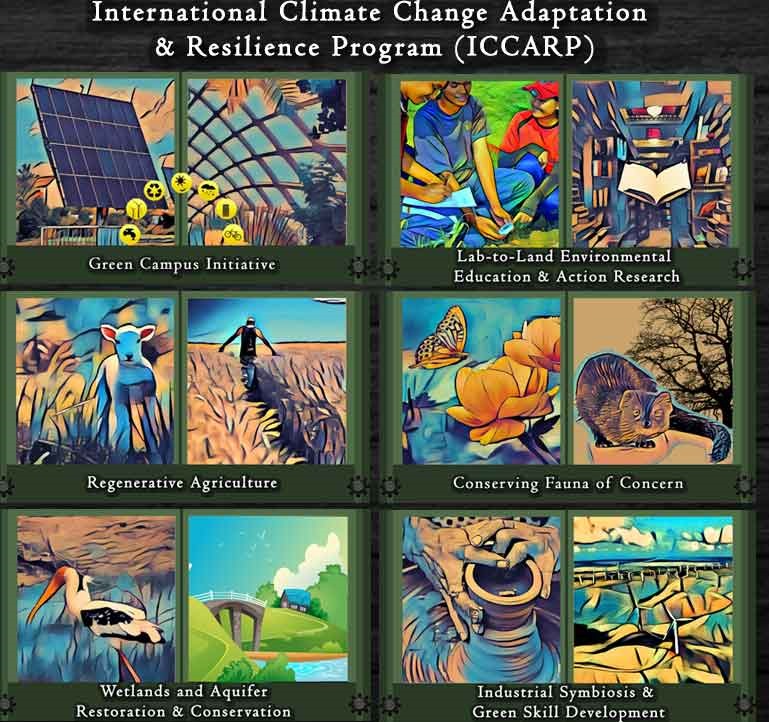
ICCARP delivers its mission through six interconnected flagship programs — spanning campuses, communities, ecosystems and rural economies.

ICCARP — International Climate Change Adaptation & Resilience Program

Flagship programs

What ICCARP delivers.

ICCARP program 0101

Green Campus Initiative

Top-down · Symbolic commitment

A three-pronged model — the Talloires Declaration, Green Protocol compliance and the Sulitest literacy assessment — that helps institutions rethink their environmental culture and cut their ecological footprint.


ICCARP program 0202

Lab-to-Land Environmental Education

Bottom-up · Action research

Bridging classroom knowledge and real-world action across the water–food–energy–biodiversity–waste nexus, turning environmental awareness into responsible behaviour through experiential learning.

ICCARP program 0303

Regenerative Agriculture

Whole system · Topsoil restoration

Restoring soil health, biodiversity and water cycles through no-till methods, diverse rotations, cover cropping and managed grazing — sequestering carbon while securing healthy, organic food.

ICCARP program 0404

Conserving Fauna of Concern

Joint action · Species networks

Protecting vulnerable species — the Peacock, Pondicherry Shark, House Sparrow, Olive Ridley Turtle and more — through species networks, habitat restoration, community stewardship and policy alignment.

ICCARP program 0505

Wetlands & Aquifer Restoration

Mobilization · Habitat conservation

Safeguarding the ecosystems that store twice the carbon of forests — restoring wetlands and recharging aquifers through management plans, threat mitigation and community governance.

ICCARP program 0606

Industrial Symbiosis & Green Skill Development

Refabricating · Circular economy

Turning one industry's waste into another's input — advancing the circular economy, revitalizing rural village industries and equipping communities with green skills for sustainable livelihoods.

Spotlight · Green Campus Initiative

A model for sustainable development.

Spearheaded by APSCC, the Green Campus Initiative encourages institutions to rethink their environmental culture through a three-pronged approach:

1

Talloires Declaration

A ten-point action plan for sustainability in education, operations and outreach — the first formal declaration integrating sustainability into academia, signed in 1990.

2

Green Protocol Compliance

A baseline-mapping tool across seven areas — water, soil, clean air, energy, waste and resource use — developed with Pondicherry University and the Government of Puducherry.

3

Sulitest

The UN-recognised Sustainability Literacy Test that assesses and strengthens environmental awareness among students and staff, contributing directly to SDG 4.7.

National-level awareness

Scaling sustainability across India.

The National Level Green Campus Initiative Awareness Program (NLGCIP) mobilizes institutions nationwide — driving Talloires commitments, Green Protocol strategic planning and Sulitest-led education — while aligning campuses with THE, QS, NIRF and NAAC rankings.