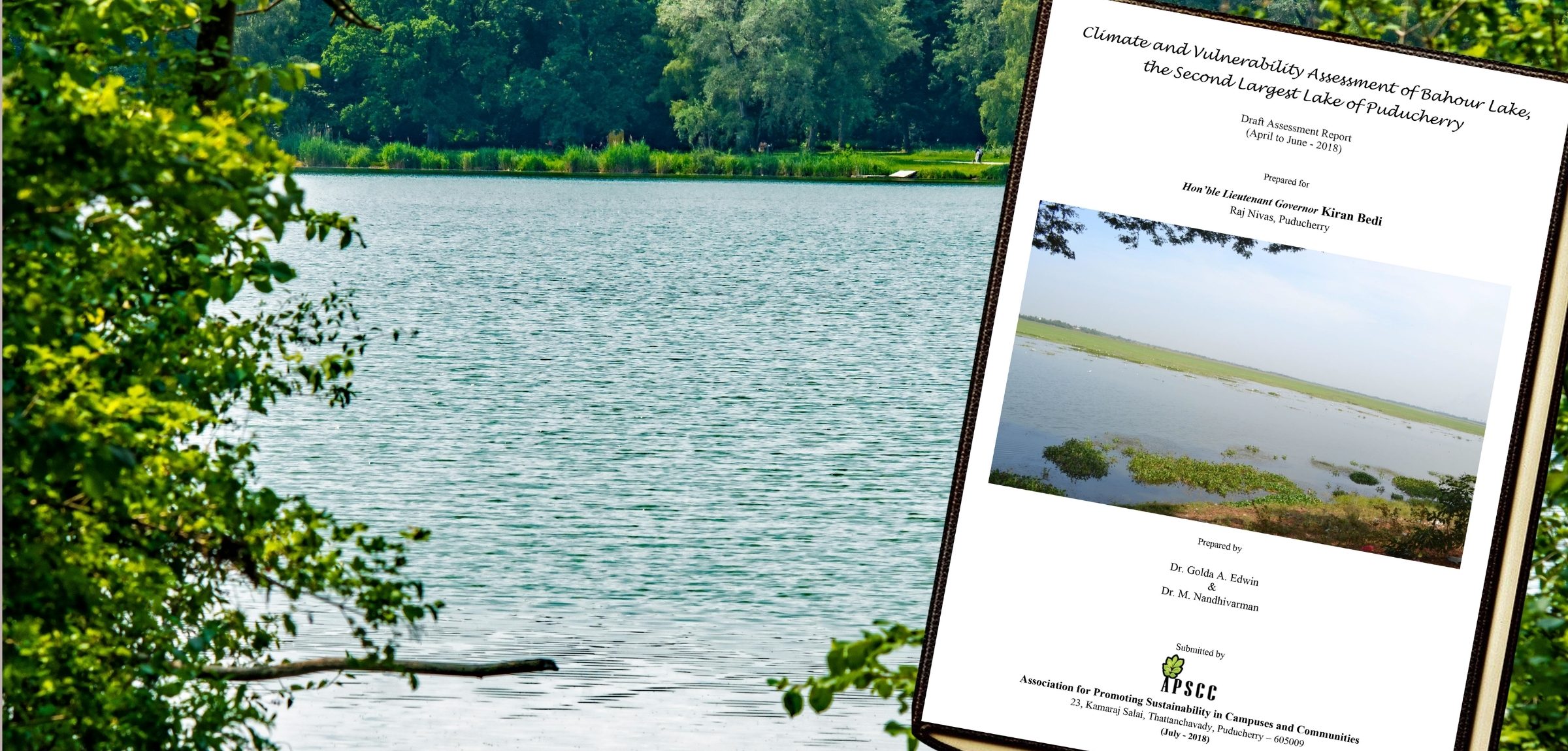
Bahour Lake — the second-largest freshwater lake in Puducherry — is a lifeline for both people and wildlife. Recognised as an Important Bird Area (IBA), it hosts over 25,000 waterfowl each season, yet mounting pressures threaten its future. APSCC, in partnership with Pondicherry University, carried out a comprehensive climate and vulnerability assessment to understand these risks and chart a path toward sustainable management.
A wetland of national significance
Located in the Bahour Commune, Bahour Lake is the second-largest lake in the union territory of Puducherry. Fed by the Bangaru Vaikkal feeder channel, it forms part of a wider network of interconnected water bodies that sustain agriculture, groundwater recharge, and rich biodiversity. Its designation as an Important Bird Area reflects its ecological value: the lake is a seasonal refuge for tens of thousands of migratory and resident waterfowl, including the Eurasian Wigeon and the Little Grebe.
The assessment was initiated under the leadership of the then Lieutenant Governor of Puducherry, Dr. Kiran Bedi, who championed the cause of restoring and protecting the territory's freshwater ecosystems. APSCC and Pondicherry University together designed a site-specific study to move beyond generalised concern and instead pinpoint the precise pressures acting on the lake.
Twenty-six threats — mapped and measured
Rather than treating the lake as a single problem, the study broke down its vulnerability into 26 distinct, site-specific threats. These ranged from encroachment and pollution to hydrological disruption of the Bangaru Vaikkal feeder channel, invasive species, unregulated human activity, and the compounding pressures of a changing climate. By quantifying each threat individually, the team could prioritise interventions where they would matter most.
The Green Protocol: a roadmap for sustainable lake management
Out of this analysis, APSCC and Pondicherry University developed a Green Protocol — a practical framework for managing Bahour Lake in a way that balances conservation with community benefit. The protocol reimagines the lake not as a resource to be exploited, but as a shared ecological asset to be stewarded for generations. Its central recommendations include:
- Floating wetlands — engineered vegetation islands to filter water and expand habitat.
- Eco-tourism & guided tours — channelling visitor interest into revenue that funds conservation.
- Dedicated birdwatching zones — protecting waterfowl while creating a draw for nature tourism.
- Plastic-free, litter-free & no-horn zones — reducing pollution and disturbance around the lake.
Together these measures aim to restore the hydrological health of the lake, safeguard its role as an IBA, and embed the local community as active partners in its protection.
Aligned with the Sustainable Development Goals
The Bahour Lake initiative advances several of the UN Sustainable Development Goals — from good health and clean water to sustainable communities, climate action, and the protection of life on land.
Explore more of our conservation work on the Our Work page.