
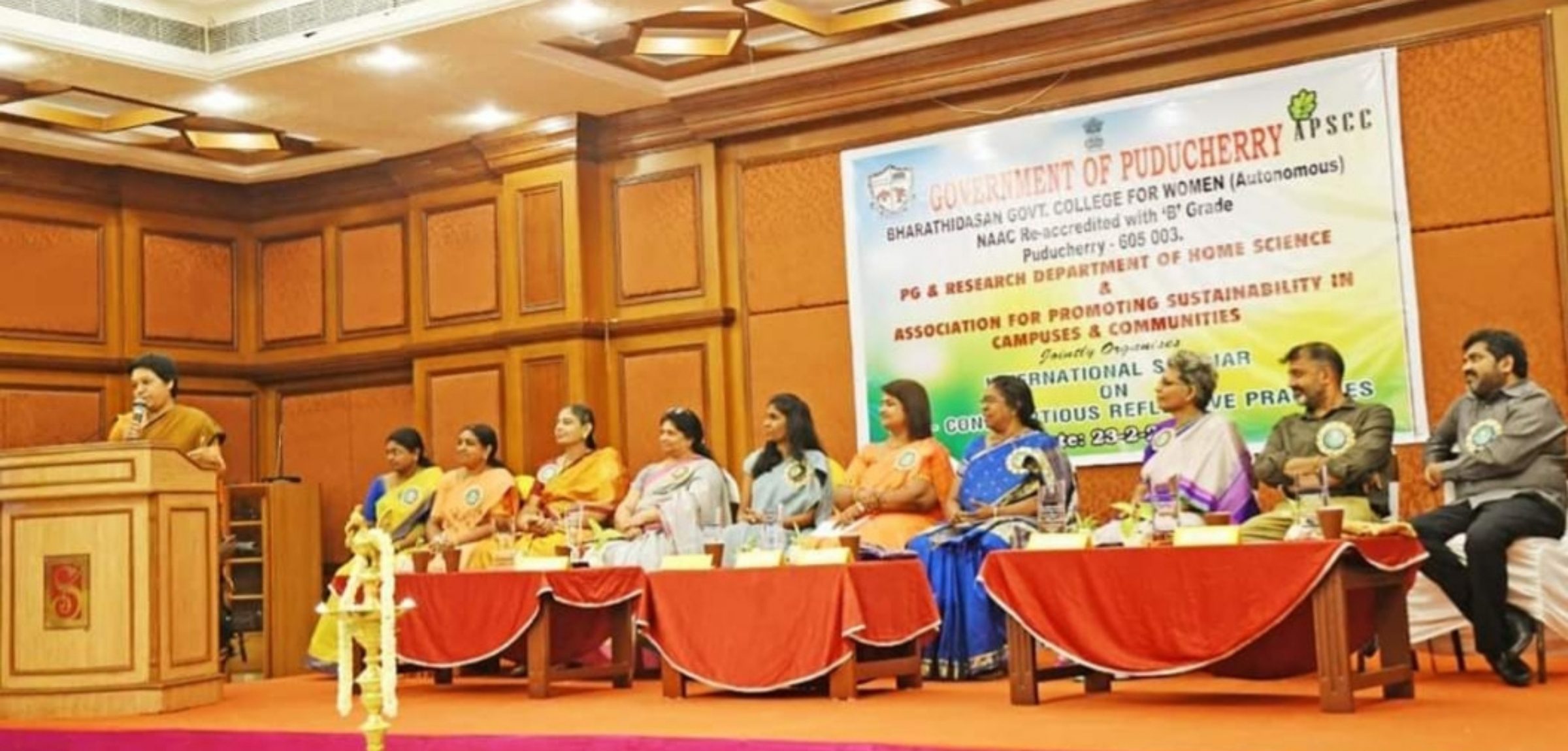
What if the first step toward saving the planet is not a policy, a technology or a target — but a pause to reflect? That question animated the International Seminar on Eco-Conscientious Reflective Practices, co-hosted by APSCC and Bharathidasan Government College for Women (BGCW), which drew more than 200 delegates into a shared inquiry: how do we deepen awareness of our environmental footprint, and then act on it?
The theme — eco-conscientious reflective practices — describes the intentional actions and thought processes that help individuals and institutions become more conscious of their impact on the natural world. It reframes sustainability not as a checklist of behaviours, but as a habit of mind: noticing, questioning and re-examining the everyday choices that ripple outward into ecosystems.
Held on the campus of one of Tamil Nadu's foremost government colleges for women, the seminar carried a particular resonance. Women's colleges in India have long been engines of social change, and BGCW's convening power brought together students, educators, researchers and practitioners from diverse sectors — each arriving with a different vantage point on the same shared crisis.
A dialogue across disciplines
The programme wove together inspirational keynotes, interactive workshops, research presentations and panel discussions — a deliberate blend of the intellectual and the experiential. Speakers examined the psychology of eco-consciousness, probing why awareness so often fails to translate into action, and how reflection can close that gap.
Other sessions explored the role of education in sustainability, the impact of reflective practices on resource conservation, and the pressing realities of climate change, biodiversity loss and eco-friendly technologies. Rather than treating these as separate silos, the seminar insisted on their interdependence: a warming climate, a fraying web of life and a wasteful economy are all symptoms of the same disconnection from nature.
From insight to habit
The most powerful sessions turned inward. If eco-consciousness begins with attention, then the discipline of reflection — practised in classrooms, workplaces and homes — becomes the mechanism by which good intentions harden into durable habits. Participants were urged to adopt sustainable habits, to incorporate reflection into their workplaces, and to educate for change, carrying the seminar's spirit back into the institutions they represent.
That is the quiet radicalism of the reflective approach: it locates the work of sustainability not only in distant summits and grand commitments, but in the ordinary, repeated moments where each of us decides how to live.
Aligned with the SDGs
The seminar advanced several of the United Nations Sustainable Development Goals — anchoring quality education, climate action, strong institutions and global partnership in a single, reflective frame:




When we learn to pause and truly see our place within nature — not above it, but woven into it — reflection stops being a private act and becomes the seed of a shared transformation.
By its close, the gathering felt less like a conclusion than a departure point. As the organisers put it, this was not just an event — it was the beginning of a movement: a widening community of people determined to think more deeply, live more lightly, and hold one another to a higher standard of care for the world we share.
Event: International Seminar on Eco-Conscientious Reflective Practices, co-hosted by APSCC and Bharathidasan Government College for Women (BGCW) · November 2021.