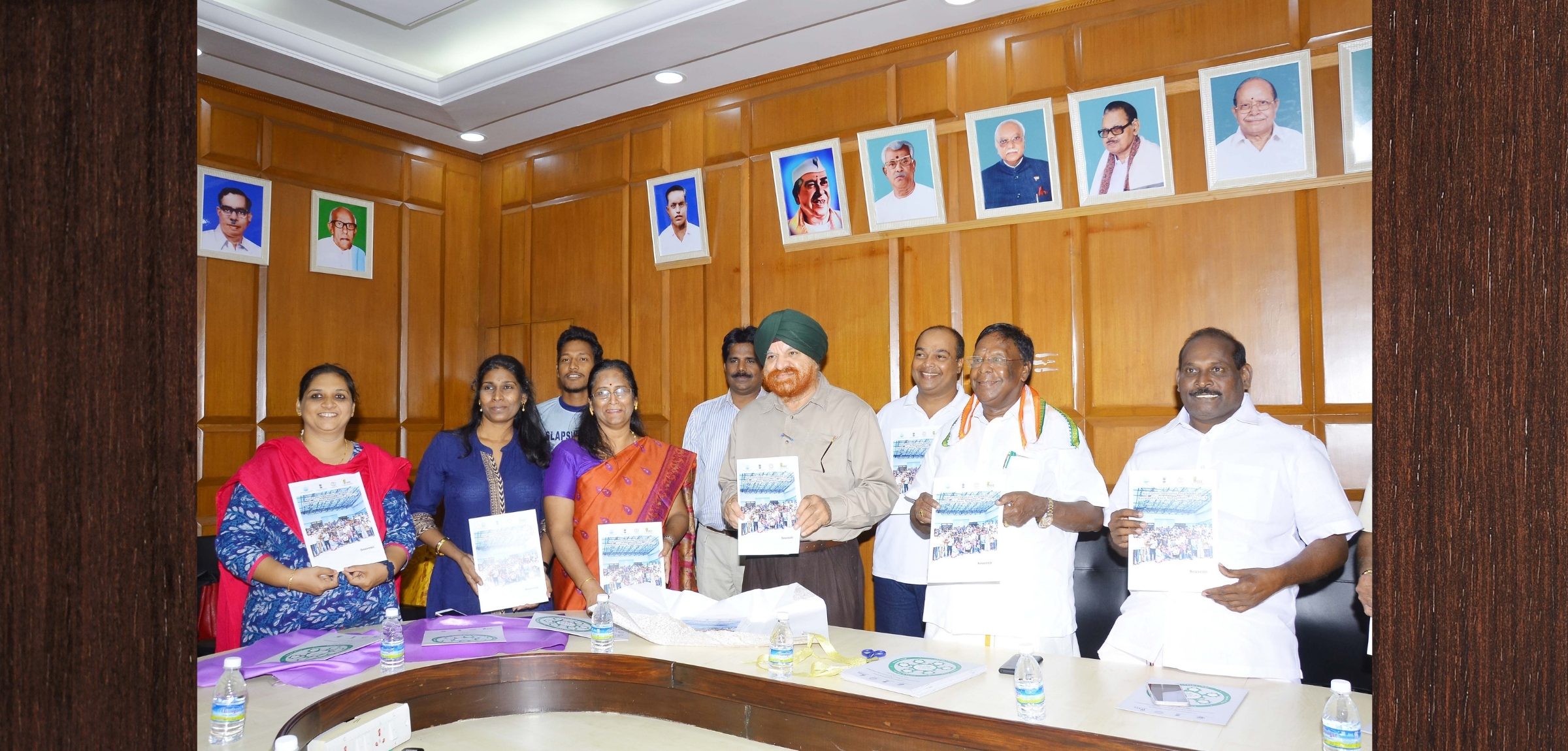
The Comprehensive Green Protocol (CGP) — developed jointly by APSCC, Pondicherry University, the Puducherry Pollution Control Committee (PPCC) and the Department of Science, Technology & Environment (DST&E) — was launched as a practical framework to help educational institutions, industries, residences and organizations across Puducherry adopt sustainable practices.
Also known as the "Green Protocol — A Milestone for Sustainable Development," the CGP responds to a defining challenge of our time: how a rapidly developing nation of more than 1.2 billion people can pursue growth without eroding the ecological systems that sustain it. For Puducherry — a low-lying coastal Union Territory acutely exposed to climate variability, sea-level rise and resource pressures — the question is not abstract but immediate.
A shared framework, four partners
The CGP was built through collaboration across government, academia and civil society. The DST&E and the PPCC brought regulatory and environmental oversight, Pondicherry University contributed academic and scientific grounding, and APSCC anchored the framework in on-the-ground sustainability practice. Together these partners shaped a protocol designed to be adopted — not merely referenced.
What the protocol covers
Rather than treating sustainability as a single intervention, the CGP integrates a set of mutually reinforcing practices that any institution can phase in over time. Its core pillars span land use planning, resource management, waste segregation, energy efficiency, and environmental education — recognising that durable change comes from aligning how spaces are planned, how resources flow through them, and how the people within them are informed and engaged.
Grounded in national and global commitments
The protocol is deliberately aligned with the frameworks that guide India's environmental agenda and the wider international consensus. It draws on the National Action Plan on Climate Change (NAPCC), the United Nations Sustainable Development Goals (SDGs), the principles of the Rio Declaration, and India's 2016 Waste Management Rules — situating local action within a coherent national and global mandate.
A four-step path to implementation
To make adoption achievable, the CGP sets out a clear four-step sequence: stakeholder engagement to build shared ownership; awareness and training to develop capacity; infrastructure to enable sustainable operations; and monitoring and reporting to track progress and sustain accountability. Educational institutions are prioritised as the natural starting points — as spaces of learning, they can model good practice and cultivate the next generation of environmentally responsible citizens.
Advancing the Sustainable Development Goals
By linking classroom learning to campus operations and community outcomes, the CGP contributes directly to six of the UN Sustainable Development Goals:

Developed by DST&E, PPCC, Pondicherry University and APSCC. Launched 13 April 2018 as a framework for sustainable practice across Puducherry. Explore more of our work on the Our Work page.