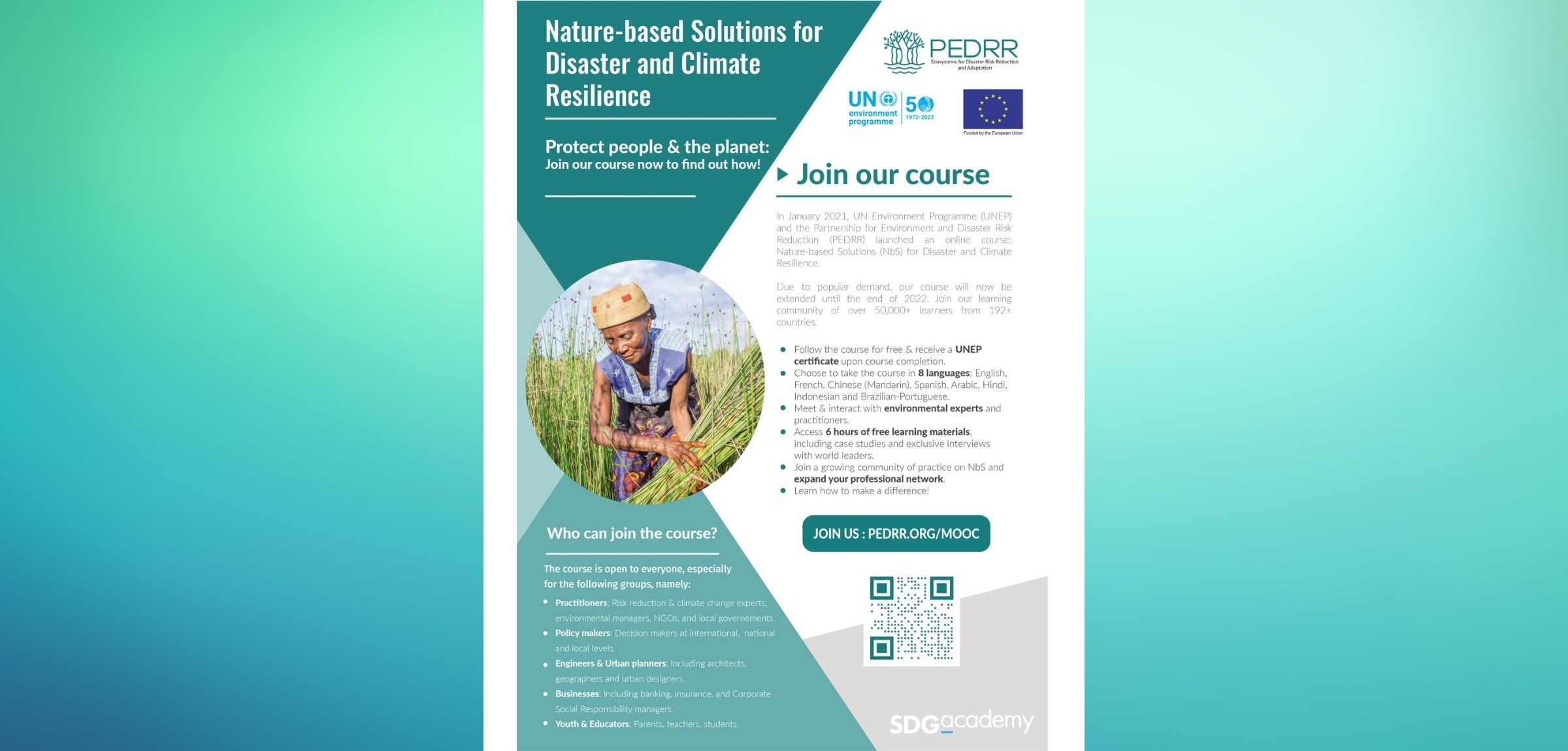
As a supporting partner, APSCC endorsed the UNEP/PEDRR course on Nature-based Solutions for Disaster and Climate Resilience — a free, multilingual programme on the SDG Academy/edX platform that has reached 50,000 learners from 192 countries, equipping practitioners, policymakers and students to work with nature rather than against it.
Offered by the UN Environment Programme (UNEP) and the Partnership for Environment and Disaster Risk Reduction (PEDRR), and extended with the support of the European Union, the course opens the science and practice of Nature-based Solutions (NbS) to anyone, anywhere. Learners complete six hours of free material — including exclusive interviews with world leaders — and earn a UNEP course certificate on completion.
Delivered through the SDG Academy on edX, the course is available in eight languages — English, French, Chinese (Mandarin), Spanish, Arabic, Hindi, Brazilian-Portuguese and Indonesian — and uses animations, 360° VR videos and real-life examples to make complex ecosystem science accessible. Beyond the lessons, it nurtures a growing global community of practice on NbS.
What are Nature-based Solutions?
As defined by IUCN and adopted across the UN system, Nature-based Solutions are actions to protect, sustainably manage and restore natural and modified ecosystems that address societal challenges — from climate change and disaster risk to water security and human well-being — while simultaneously benefiting biodiversity. In practice, that means restoring mangroves to buffer storm surges, rebuilding wetlands to filter water and absorb floods, greening cities to cool them, and managing forests and soils to lock away carbon.
Rather than replacing engineered infrastructure entirely, NbS work alongside it — often at lower cost and with wider co-benefits. A healthy coastal wetland protects communities from flooding and supports fisheries, sequesters carbon and sustains livelihoods, all at once.
Why Nature-based Solutions matter
NbS are increasingly recognised as one of the most cost-effective and scalable tools we have. Studies estimate that natural climate solutions could provide up to 30% of the climate-change mitigation needed by 2030 to keep warming in check. At the same time, they deliver disaster risk reduction — coral reefs, mangroves and floodplains absorb the force of storms and floods — while restoring habitats, safeguarding food security and protecting the freshwater on which billions depend.
Crucially, NbS place ecosystems and communities at the centre of resilience-building. They protect people and the planet in the same act — which is precisely why UNEP and PEDRR built an open, global course to spread the knowledge as widely as possible.
NbS and the UN Decade on Ecosystem Restoration
The course launched at the dawn of the UN Decade on Ecosystem Restoration (2021–2030) — a global rallying call to prevent, halt and reverse the degradation of ecosystems on every continent. Nature-based Solutions are the operational heart of the Decade: they turn the ambition of restoration into concrete action on coastlines, in cities, across farmland and along rivers.
This alignment sits squarely within APSCC's own mission. Our work to restore and protect ecosystems — and to build the next generation of practitioners who can lead it — draws directly on the principles the UNEP/PEDRR course teaches.
How this aligns with APSCC's work
APSCC's flagship programmes are, in essence, Nature-based Solutions in practice. The Green Protocol for Wetlands restores and protects the wetlands that store carbon, filter water and shield communities from floods. The Green Campus Initiative greens institutions and cities to cool, clean and connect them to nature. And our ICCARP climate-adaptation and resilience programmes apply NbS thinking to help communities prepare for a changing climate.
By serving as a supporting partner to the UNEP/PEDRR course, APSCC helped extend this knowledge to a worldwide audience — reinforcing our belief that resilience is best built with nature, at scale, and in the hands of empowered local practitioners.
Aligned with the SDGs
Nature-based Solutions — and this course — advance a cluster of interlinked Sustainable Development Goals, from climate action and life on land to sustainable cities and clean water:
Course: Nature-based Solutions for Disaster and Climate Resilience — offered by UNEP and PEDRR on the SDG Academy / edX platform, with support from the European Union. APSCC served as a supporting partner · Posted 12 September 2021.