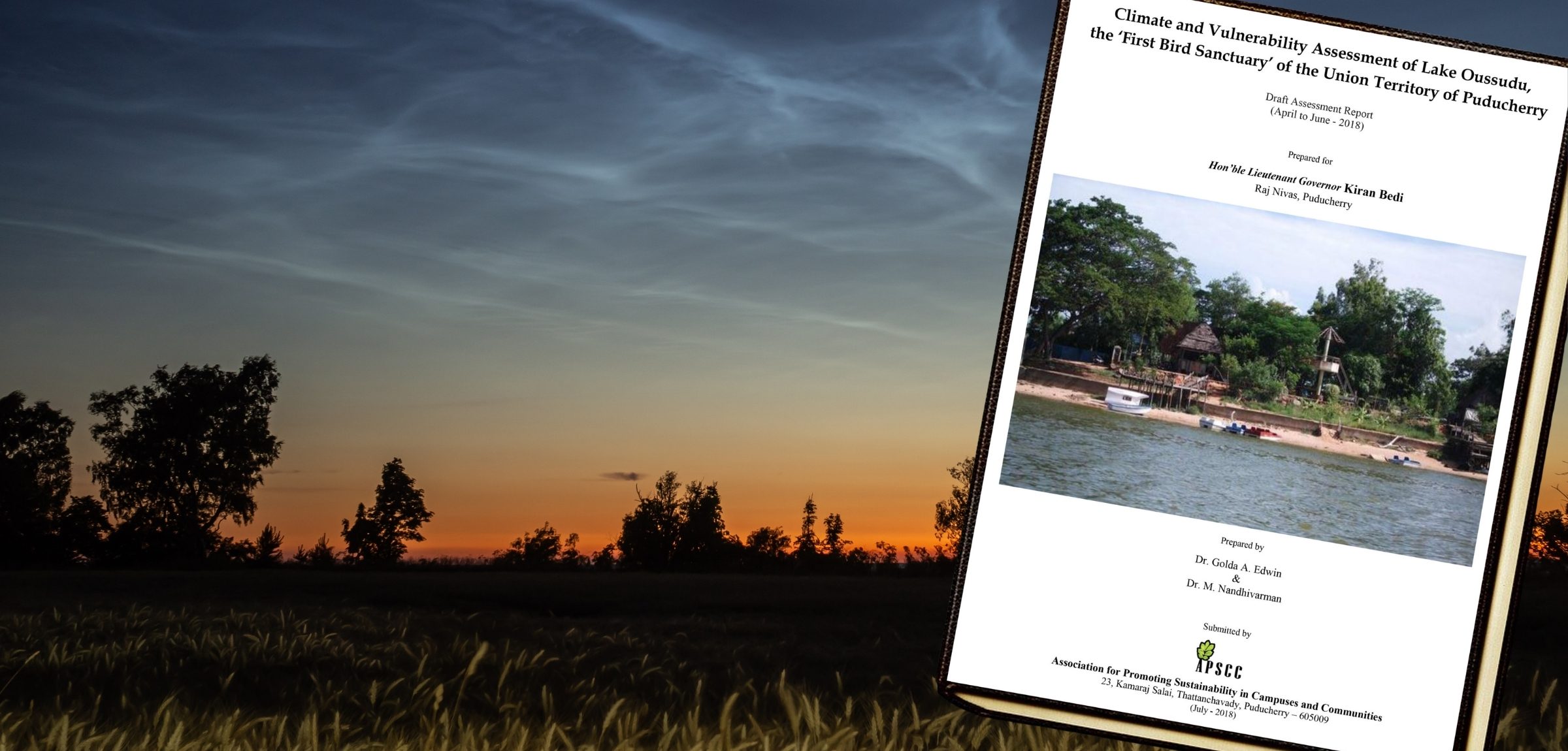
APSCC collaborated with Pondicherry University and the office of Lt. Governor Dr. Kiran Bedi to carry out a comprehensive climate and vulnerability assessment of Oussudu Lake — Puducherry’s first declared bird sanctuary — identifying 39 distinct threats and recommending a roadmap that balances conservation with responsible eco-tourism.
Oussudu Lake (Ousteri) is one of the most significant freshwater wetlands in the Puducherry region and a haven for migratory and resident birdlife. Recognising its ecological importance, the study was initiated at the behest of Lt. Governor Dr. Kiran Bedi and undertaken by Dr. Golda Edwin and Dr. Nandhivarman of Pondicherry University in partnership with APSCC.
Listed under the Ramsar Convention on Wetlands of International Importance, Oussudu supports a rich mosaic of biodiversity — birds, butterflies, amphibians, reptiles and a diverse assemblage of aquatic and terrestrial plants. Protecting this wetland is central to safeguarding the ecological services and habitat it provides across the region.
Mapping the threats
The assessment adopted a structured vulnerability framework, cataloguing pressures on the lake across three dimensions — human, natural and climate-driven — to prioritise interventions where they matter most:
Human pressures dominated the picture — encroachment, pollution, discharge and disturbance to habitat — while natural and climate-linked stressors compounded the lake’s exposure. Framing the risks in this way allowed the team to distinguish reversible, management-driven threats from longer-term climate vulnerabilities.
The study team
The assessment brought together academic expertise and civil-society action under the leadership of the Lieutenant Governor’s office:
Pathways for conservation and eco-tourism
Rather than treating protection and public engagement as opposing goals, the study recommended interventions that restore the wetland while inviting the community to value it. Key recommendations included:
Floating wetlands to improve water quality and habitat; artificial lake islands to create safe nesting and roosting refuges for birds; walking trails along the shoreline for low-impact access; and birdwatching towers to enable observation without disturbing the sanctuary’s inhabitants.
Aligned with the SDGs
The Oussudu assessment advances a cluster of Sustainable Development Goals — spanning clean water, sustainable communities, climate action, and life below and above water:



Protecting Oussudu is not a choice between people and nature — it is a shared responsibility. A well-managed sanctuary can be both a refuge for biodiversity and a source of pride for the community.
Study: Climate & Vulnerability Assessment of Oussudu Lake — Pondicherry University in collaboration with APSCC, initiated by the Office of the Lieutenant Governor of Puducherry · 25 August 2018.