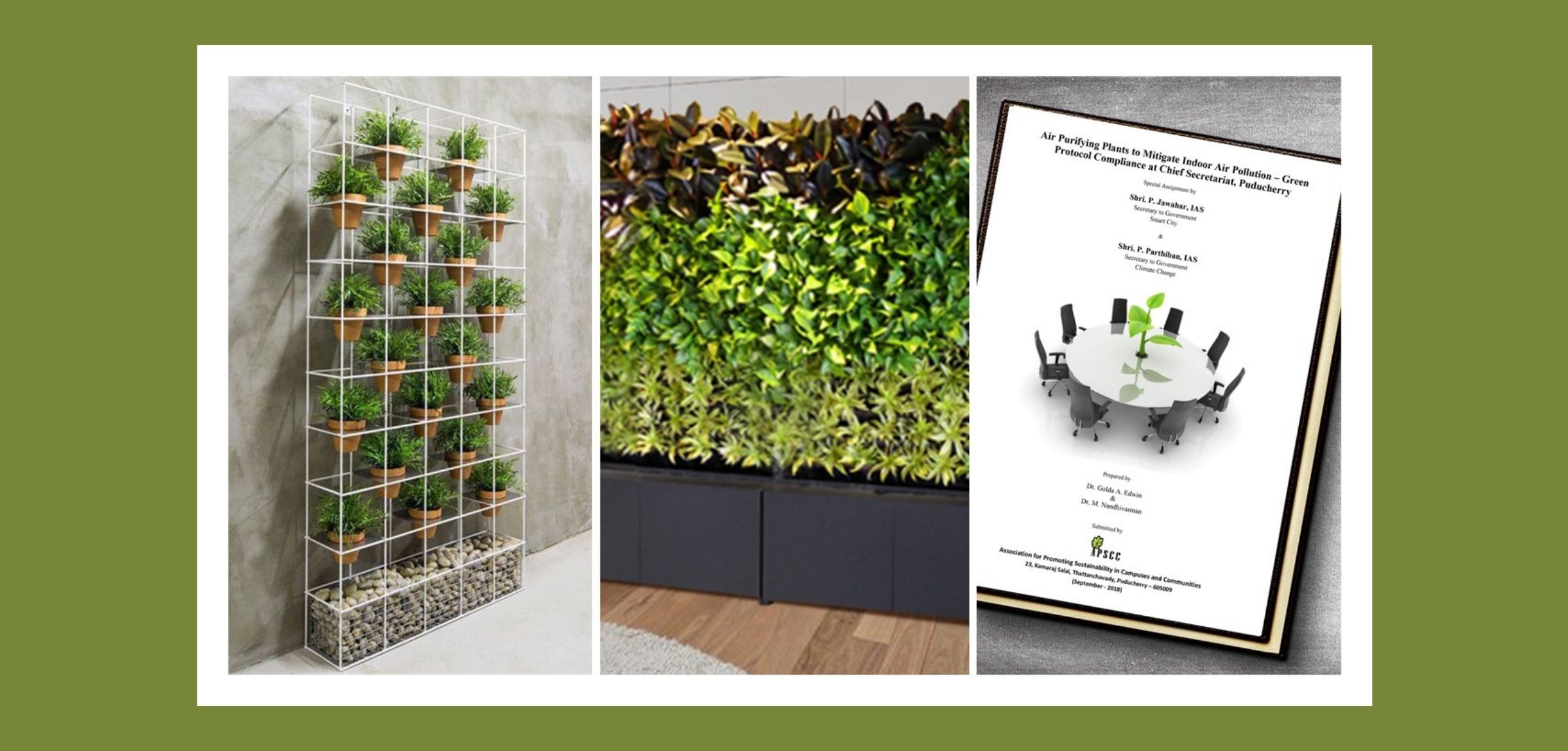
APSCC partnered with the Chief Secretariat of Puducherry to introduce air-purifying plants — backed by NASA’s Clean Air Study — as part of the Comprehensive Green Protocol, tackling VOCs, benzene and formaldehyde in government offices.
The initiative was taken up in collaboration with the Chief Secretariat under the guidance of Shri P. Jawahar IAS (Secretary – Smart City) and Shri P. Parthiban IAS (Secretary – Climate Change), positioning the Secretariat as a model for mitigating indoor air pollution through nature-based solutions.
The problem: indoor air pollution
Enclosed office spaces accumulate a surprising range of pollutants — volatile organic compounds (VOCs), particulate matter and carbon monoxide among them. Common sources include asbestos, carbon monoxide, formaldehyde from pressed-wood products, nitrogen dioxide, pesticides, secondhand smoke and everyday appliances. Left unaddressed, these degrade air quality, comfort and productivity for the people who work there every day.
The solution: NASA Clean Air plants
NASA’s Clean Air Study identified a set of common houseplants with proven air-purifying properties — each capable of removing specific pollutants such as formaldehyde, benzene, xylene, toluene, trichloroethylene and ammonia. APSCC recommended 12 of these species for integration into the Secretariat’s office spaces:
The full set of recommended species also includes English Ivy, Aloe Vera, Bamboo Palm, Gerbera Daisy, Rubber Plant and Philodendron — each contributing to cleaner indoor air while adding greenery to the workspace.
From offices to entrepreneurship
Beyond the Secretariat, the model is designed to scale: it can be replicated across other government and private institutions, and promoted through local nurseries as an avenue for green entrepreneurship. The broader goals are clear — cleaner indoor air, improved productivity, green aesthetics, and greater awareness of everyday sustainability.
Aligned with the SDGs
The initiative advances several Sustainable Development Goals — supporting good health, sustainable cities, responsible consumption and life on land:



The most affordable air purifier in the world grows in a pot. Nature has already solved this problem — we just need to invite it inside.
Program: Comprehensive Green Protocol — Mitigating Indoor Air Pollution at the Chief Secretariat, Puducherry · January 2019.