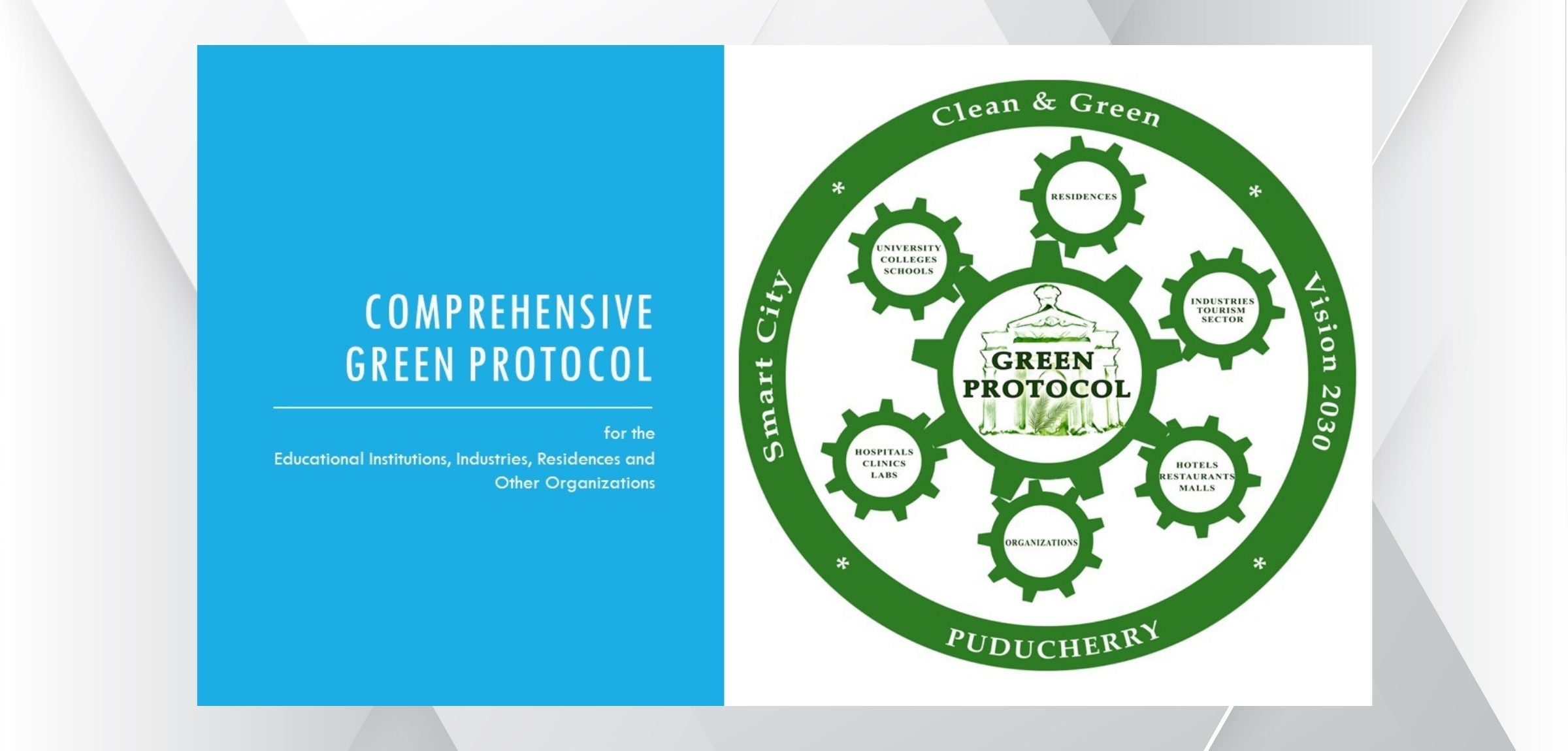
APSCC partnered with the Chief Secretariat of Puducherry to implement a Comprehensive Green Protocol — more than 40 green measures spanning energy, water, air quality, waste, furnishings and everyday practice — establishing a working model for sustainable government offices in India.
The initiative was carried out in collaboration with Shri P. Jawahar IAS (Secretary — Smart City) and Shri P. Parthiban IAS (Secretary — Climate Change). Grounded in Principles 8, 15 and 21 of the Rio Declaration, the Green Protocol was designed to reduce the office's environmental footprint, foster eco-friendly practices, enhance indoor and outdoor environmental quality, and educate employees on sustainable living.
Seven areas of action
The Green Protocol organised more than forty distinct measures across seven interconnected focus areas — each targeting a different dimension of the office's daily operations and environmental impact.
A phased rollout
Implementation followed three deliberate phases — building a strong foundation of assessment before scaling measures and embedding continuous review.
A replicable model
By demonstrating that a functioning government office can meaningfully cut its environmental footprint while improving the working environment for staff, the Chief Secretariat project offers a template that other public institutions across India can adapt and replicate.
Sustainability is no longer a choice but a necessity — small changes in how we work can lead to outsized impact on the planet.
Aligned with the SDGs
The Green Protocol directly advances several Sustainable Development Goals — from clean energy and sustainable cities to responsible consumption and climate action:


Program: Green Protocol Compliance at the Chief Secretariat, Puducherry · 29 July 2019 · in partnership with the Chief Secretariat of Puducherry.