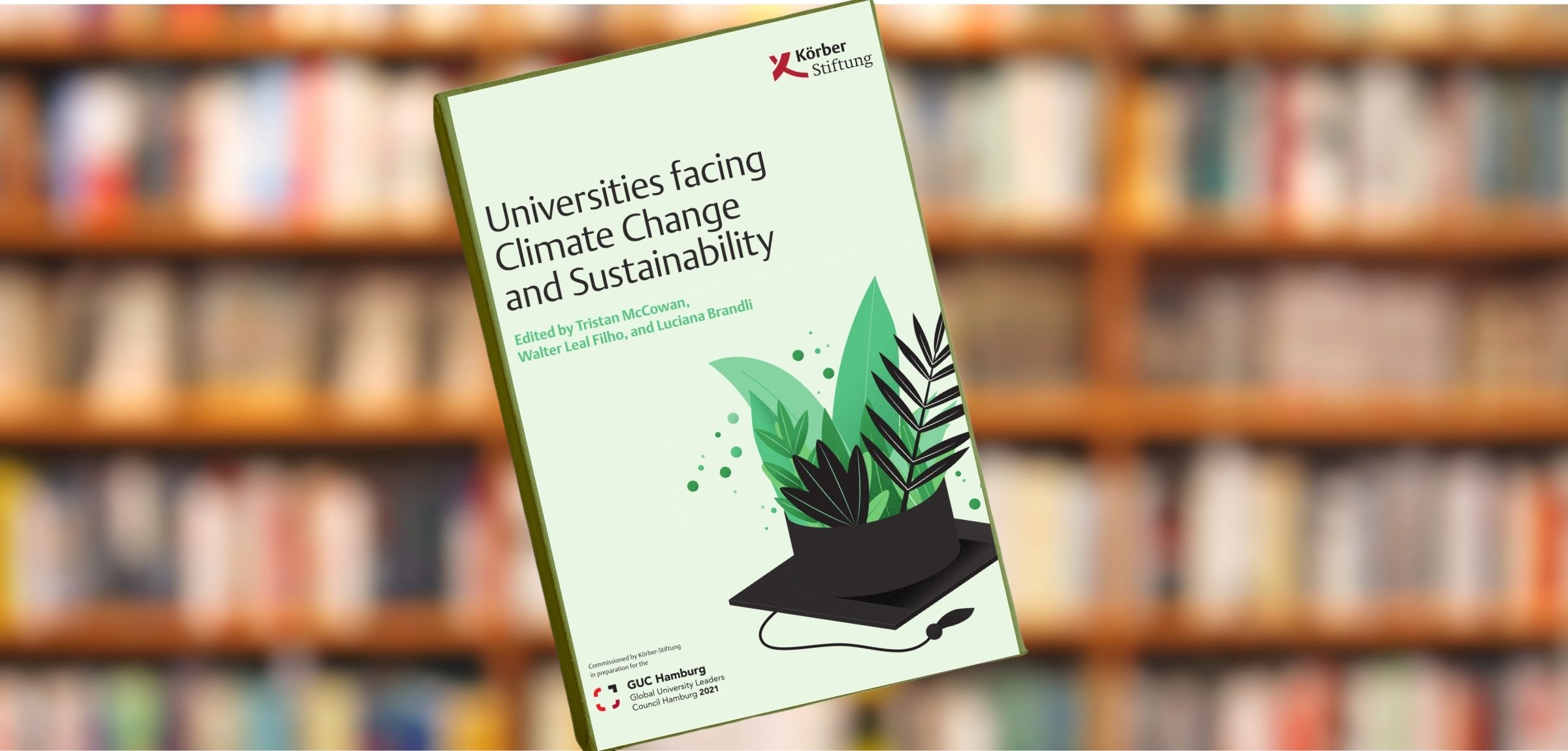
In July 2021, a landmark international study — Universities Facing Climate Change and Sustainability — set out a clear proposition: the world's universities must move from studying the climate crisis to actively leading the transition. APSCC's Dr. Golda A. Edwin and Dr. M. Nandhivarman contributed the India chapter to this seven-country inquiry.
Commissioned under the research project "The role of higher education in addressing challenges of sustainability and climate change — leadership and governance," the study was supported by the Körber Foundation on behalf of the Global University Leaders Council (GULC). It brought together contributors from seven countries to compare how higher-education systems govern themselves for sustainability, and where the deepest gaps lie.
A study spanning seven nations
The report examined higher-education leadership and governance for sustainability across Brazil, Germany, India, Japan, South Africa, the United Kingdom and the United States of America. Each country-level deep dive was paired with cross-national lessons learned and a set of recommendations for future action — offering university leaders a comparative map of what works, and what holds institutions back.
Why universities are uniquely positioned to lead
Universities sit at a rare intersection of influence. They generate the research that underpins climate policy; they educate the professionals, citizens and leaders who will implement the transition; they anchor and convene their surrounding communities; and — often overlooked — they operate large campuses whose procurement, energy use and estate operations are sizeable footprints in their own right. No other institution combines knowledge production, human-capital formation, civic convening power and material operational scale in quite the same way.
That breadth is exactly why the study argues universities should not confine themselves to observing the climate crisis from a distance. They can model the transition on their own campuses and, in doing so, become living demonstrations for the cities and regions around them.
The governance gap
The study's most pointed finding is a structural one: many universities have sustainability goals, but lack the institutional mechanisms to deliver them. Ambitions announced in strategy documents too often fail to translate into dedicated offices, clear lines of accountability, budgeted mandates or transparent public reporting. Sustainability becomes everyone's concern and no one's responsibility.
Universities must lead the transition to sustainability — not merely study it. The task is to close the gap between climate ambition and institutional action.
India's context
India's higher-education landscape — its IITs, IIMs and central universities — carries enormous convening and demonstration potential. The National Education Policy (NEP) 2020 further embeds sustainability into the mandate of institutions, calling for environmental awareness, education for sustainable development, and community engagement to be woven through the curriculum. The India chapter mapped this policy momentum against the on-the-ground reality of how campuses are actually governed for sustainability.
Cross-national lessons learned
Across all seven countries, the study surfaced a consistent set of enablers. Institutions that make real progress tend to establish dedicated sustainability offices with genuine authority; they build student-led governance into decision-making rather than treating students as an audience; and they commit to transparent reporting of targets and performance so that progress can be tracked and held to account.
How APSCC turns the findings into action
The study's central diagnosis — ambition without mechanism — is precisely the gap APSCC's Green Campus for Green Cities (GCGC) programme is built to close. GCGC gives institutions a practical framework to translate sustainability goals into campus governance, operations and community outcomes, positioning universities as engines of green urban transformation rather than passive holders of green intentions.
Aligned with the SDGs
The study and APSCC's contribution advance the following Sustainable Development Goals — reinforcing quality education, decisive climate action, and the partnerships needed to deliver both:



Study: "The role of higher education in addressing challenges of sustainability and climate change — leadership and governance" · Supported by the Körber Foundation on behalf of the Global University Leaders Council (GULC) · Report: guc_study_universities_facing_climate_change_and_sustainability · July 2021. Country contributors from APSCC (India chapter): Dr. Golda A. Edwin and Dr. M. Nandhivarman.